
On the Mongolian steppe, a family can take its ger down in about an hour and load it onto two or three pack animals, while in an Oregon state park the same word describes a round room on a wooden deck, lit by an acrylic dome and built to stay put for decades. Between the two stand the tall felt domes of Kazakh and Kyrgyz herders and the canvas yurts of French and British glamping sites. You can tell these types of yurts apart from the doorway by three things, the shape of the roof poles, what holds up the crown and what covers the walls, and those same details tell you what kind of night you will spend inside.
Key takeaways
What makes a yurt a yurt?
The wall of a yurt is a lattice of crossed wooden laths that opens out like an accordion, in sections the Mongolians call khana and cut from willow, birch or poplar. Roof poles run from the top of this wall to a wooden ring, the crown, whose opening lets smoke out and daylight in. A tension band circles the top of the wall, woven cloth or rope on the steppe and steel cable in modern yurts, and stops the lattice from spreading under the outward push of the roof. The frame is lashed together with leather thongs and ropes of animal hair, then wrapped in felt made from the herd’s own wool, often three to five layers under an outer canvas.
Anatomy of a yurt
Seven parts, two traditions
Tap a number to name each part, then switch between the Mongolian ger and the Kazakh and Kyrgyz yurt to see the roof change.
3. The crown
Toono in Mongolian
A heavy wooden ring that lets stove smoke out and daylight in, closed with a felt flap in bad weather. It outlasts the rest of the frame.
Cutaway drawing, front wall removed, not to scale. Local names in Mongolian, Kazakh and Kyrgyz.
Steppe herders made that felt by soaking the wool, rolling it around a pole inside a hide and dragging the bundle behind a galloping horse until the fibres locked into a dense, windproof sheet.
Yurt comes from an old Turkic word for a dwelling or a homeland and reached English through the Russian yurta, while Mongolians simply say ger, their word for home. The shape is far older than either word: a bronze bowl from the Zagros Mountains of Iran, dated to around 600 BC, already shows one, and the Greek historian Herodotus described the felt tents of the Scythian nomads around 440 BC.
Two traditional families, told apart by their roof poles
Across Central Asia, the roof poles give away a yurt’s origin first. Straight poles and a low roof belong to the Mongolian ger, while poles steamed into a curve at their foot, lifting a steeper dome, belong to the Turkic yurts of the Kazakhs and the Kyrgyz, hence the name bentwood yurts.
The Mongolian ger, low and held up by two columns
The ger’s straight roof poles, the uni, rise gently to a heavy crown, the toono, so the roof keeps a low slope that lets the steppe wind slide over it, and the crown usually rests on two painted columns, the bagana. The traditional ger is a white felt drum with a painted wooden door facing south. Inside, the stove stands in the centre, the western half is the men’s side, the eastern half the women’s side and kitchen, and the north, opposite the door, is the place of honour, where the family altar stands and elders sit.
Guests move round clockwise, never lean on the columns and never tread on the threshold. The threshold taboo was already enforced eight centuries ago, when the Franciscan friar William of Rubruck, staying at the court of the Great Khan Möngke in 1253 and 1254, watched one of his companions strike the threshold on his way out; the guards seized him and took him before the court’s chief secretary.
UNESCO added the craft of the Mongol ger and its customs to its intangible heritage list in 2013, and the ger is still a home: at Mongolia’s 2010 census, 45.2% of households lived in one. The share had fallen by 5.7 points in ten years nationally, yet it rose among town dwellers, to 32.7% of urban households, as herders moving to the cities brought their gers with them. Around six residents of Ulaanbaatar in ten now live in the fenced ger districts ringing the capital, though many plots hold a small house beside the tent, or instead of it.
The Kazakh and Kyrgyz yurt, a taller dome with no pillars
The Kazakhs call it kiyiz üy, the felt house, and the Kyrgyz boz üy, the grey house. Its roof poles are steam-bent at the lower end, so they drop steeply to the lattice and form both the shoulder of the wall and the roof. The result is a higher, rounder dome that stands on its own, and a traditional Kazakh yurt needs no central column. Families live at floor level, on layers of felt rugs such as the Kyrgyz shyrdak and ala kiyiz, whose patterns carry wishes for the household.
The crown, shanyrak in Kazakh and tündük in Kyrgyz, carries the family’s history. Kazakh families repaired the frame and renewed the felt over the years, but passed the shanyrak from father to son, its smoke stains a record of how old the lineage was. A stylised shanyrak sits at the centre of Kazakhstan’s emblem, adopted in 1992, and if you look closely at Kyrgyzstan’s flag, you will see the tündük, viewed from inside, filling its sun, whose 40 rays stand for the tribes united by the hero Manas (a law straightened them in December 2023, after critics said the wavy version looked like a sunflower). UNESCO inscribed the making of Kyrgyz and Kazakh yurts on its list in 2014, then extended it in 2025 to the Karakalpak yurts of Uzbekistan.
The yurt on wheels of the Mongol khans
Some yurts were never taken down, because thirteenth-century Mongol nobles travelled with their gers mounted on huge carts, the ger tereg. William of Rubruck measured one: the wheels stood 20 feet apart (about 6 metres), the house overhung them by at least 5 feet on each side, and 22 oxen, in two rows of eleven, pulled it across the steppe.
How the yurt travelled to America and Europe
Western builders took up the yurt from the 1960s onwards, and each side of the Atlantic reshaped it for its own climate.
The American yurt, from a magazine photo to Oregon’s state parks
In 1962, National Geographic published Supreme Court Justice William O. Douglas’s account of a journey through Mongolia, with a sequence of photos showing herders raising a ger. Bill Coperthwaite, a Maine-born educator, saw it and spent the rest of his life adapting it, building wooden yurts with outward-flaring walls, his tapered-wall design, first at Bucks Harbor, Maine.
In 1978, Alan Bair founded Pacific Yurts in Oregon and replaced felt with architectural fabric, a vinyl-coated polyester, over a frame closed by a steel cable. Today’s American yurt stands on a wooden deck, lined with reflective bubble-foil insulation and lit by a clear acrylic dome, and a large one can take days to build. Parks made it popular, starting with Oregon, which ordered two 14-foot yurts (4.3 metres across) for Cape Lookout State Park in 1993 to test them against the coastal wind and rain, installed them in January 1994 and now counts more than 200 across its parks, according to the manufacturer.
The first two are still in use after more than thirty years, a useful benchmark for a fabric yurt on a windy coast like ours.
European and French yurts, built for wetter skies
European makers stayed closer to the Central Asian original, with local hardwoods such as ash or chestnut, but adapted it to Atlantic weather: steeper roofs to shed the rain, waterproof cotton canvas, and felt kept for colder models (French craft builders often use sheep’s wool) or left out of summer glamping yurts.
France has even written the yurt into its planning law: since the ALUR housing act of 2014 and a 2015 decree, a “demountable residence” without foundations, lived in at least eight months a year and easy to remove, can be a lawful permanent home under article R111-51 of the planning code.
Timeline
From felt on the steppe to fabric in the West
Twenty-six centuries of yurts in eleven dates. Select a date, or filter by where it happened.
c. 600 BC
A bronze bowl found in the Zagros Mountains, in today's Iran, shows the oldest known depiction of a yurt.
c. 440 BC
The Greek historian Herodotus describes the felt tents of the Scythian nomads.
1253 to 1254
William of Rubruck visits the Great Khan Möngke and measures a ger carried whole on a cart pulled by 22 oxen.
1962
National Geographic publishes Justice William O. Douglas's journey through Mongolia. Bill Coperthwaite reads it and starts building wooden yurts in Maine.
1978
Alan Bair founds Pacific Yurts in Oregon: architectural fabric and a steel cable replace felt and rope.
1993 to 1994
Oregon orders two yurts for Cape Lookout State Park, installed in January 1994 and still in use today.
2010
Mongolia's census counts 45.2% of households living in a ger, and a rising share in the towns.
2013
UNESCO lists the traditional craftsmanship of the Mongol ger as intangible heritage.
2014
UNESCO lists the knowledge and skills of making Kyrgyz and Kazakh yurts.
2014 to 2015
France's ALUR housing act and a 2015 decree let a demountable home, such as a yurt, serve as a lawful permanent residence.
2025
UNESCO extends the listing to the Karakalpak yurts of Uzbekistan.
1962
National Geographic publishes Justice William O. Douglas's journey through Mongolia. Bill Coperthwaite reads it and starts building wooden yurts in Maine.
Sources: National Geographic Education, William of Rubruck’s Itinerarium, Mongolian 2010 census (National Statistics Office), UNESCO intangible heritage files, Légifrance (article R111-51).
How to recognise each type of yurt at a glance
The comparator below sets the five types side by side: pick any two to see where they differ.
Comparator
Compare two types of yurts
Choose a type in each row. The Mongolian ger and the Kazakh and Kyrgyz yurt are shown first.
First type
Compare with
Mongolian ger
Kazakh and Kyrgyz yurt
Roof poles
Straight poles (uni), gentle slope
Steam-bent at the foot (uyk, uuk), steep dome
What holds the crown
Two painted columns (bagana)
Nothing: the bent poles hold it up
Cover
Three to five layers of wool felt under white canvas
Wool felt, with felt rugs such as the shyrdak inside
Where you meet it today
Family homes across Mongolia, ger camps for visitors
Summer pastures, weddings and festivals
For your night
Warm through winter thanks to the felt and a central stove
More headroom under the dome, life at floor level on felt
Next time you step through a yurt door, look up before anything else: columns under the crown mean a ger, poles that curve down to the wall mean a Turkic yurt, and a clear dome with a cable at wall height means a modern Western build.
What the type of yurt changes for your night
Felt explains how a ger stays warm through a Mongolian winter, when the steppe can fall to around -28 °C: several layers of wool around a central stove hold the heat evenly, and families add felt as the cold sets in. A single canvas or vinyl skin, the norm on most glamping sites, warms up quickly and cools just as quickly once the stove dies down.
A thin skin also collects condensation, because a sleeping adult breathes out about a third of a litre of water vapour in a night, according to UK housing advice, so a couple releases around two thirds of a litre by morning and the cold canvas catches it first. A flueless gas heater adds far more, about 8 pints per average bottle of gas by North Yorkshire Council’s estimate, and yurt dwellers on forums all give the same advice: keep the crown vent and a window slightly open, even in winter.
Rain drums on fabric loudly enough in a downpour to cover a conversation, which some guests love and light sleepers meet with earplugs, and in summer the same skin turns a yurt into a greenhouse by mid-afternoon unless the walls roll up and the crown opens.
Between October and April, we would only book a yurt with a stove and felt or wool insulation, and on an Atlantic coast like ours, one with a steep roof as well. Before booking, four answers tell you most of what to expect:
- Ask how the yurt is heated, by wood stove, gas or electricity, and who keeps the fire going at night.
- Check whether the walls are insulated with felt or wool, or covered by a single layer of canvas.
- Find out where the bathroom is, inside the yurt, next door or across the field.
- Look at the floor, since a raised wooden deck stays dry where a groundsheet can turn damp after rain.
Before you book
Four questions before a yurt night
Tick them off as you read a listing or talk to the host.
0 of 4 answered
A cousin of the yurt at Dihan
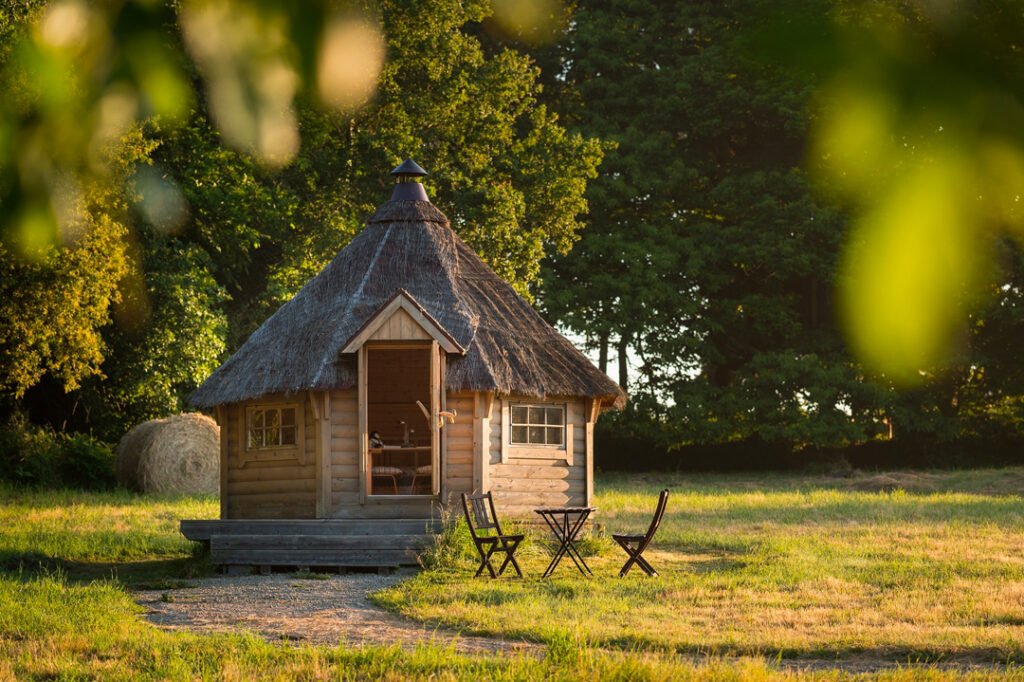
We have no yurt at Dihan, the 25-hectare, car-free estate near Carnac where we have welcomed guests into our tree houses for almost twenty years. Its closest relative here is the Lapland cottage, a Finnish kota inspired by the peoples of the Far North: an octagonal wooden hut whose roof rises to a single point, like a yurt’s crown, built of solid timber so the Breton rain stays outside. Two steps lead up from the grass to a 140 cm double bed, the dry toilet has its own little cabin next door and the showers are in the guest lounge, much like the bathroom block of a yurt camp. Heating is included from October to the end of March, breakfast arrives on the terrace every morning, and the meadow in front belongs to our horses and our donkey.
If it is the sky through the crown that you dream of, the starry dome offers it in full, through a transparent shell. And if you are still hesitating between formats, our guide to choosing between a bubble, treehouse, yurt, caravan or ecolodge compares them season by season, alongside the rest of our unusual places to stay in Brittany.
From the ger that folds onto two pack animals to the decked yurt of an Oregon park, the family likeness lies in the lattice, the poles and the crown, and the differences in the roof and the cover. Those details tell you where a yurt comes from, and whether your night will smell of wool and wood smoke or sound like rain on canvas. Dihan means “the pause” in Breton, and a round roof is a fine place to take one.
Your questions about yurts
What is the difference between a yurt and a ger?
Ger is the Mongolian word for the tent and for home, and yurt the Turkic word that reached English through Russian. In English, “ger” usually refers to the Mongolian type, with straight roof poles and two columns under the crown, while “yurt” covers every type, including the bentwood yurts of Kazakhstan and Kyrgyzstan and modern Western builds.
What is the hole at the top of a yurt called?
It is the crown: toono in Mongolian, shanyrak in Kazakh and tündük in Kyrgyz. It lets stove smoke out and daylight in, can be closed with a felt flap on the steppe, and is usually covered by a clear acrylic dome in modern yurts.
Are yurts warm in winter?
A traditional ger with several layers of felt around a stove stays warm in temperatures far below freezing. A glamping yurt with a single canvas or vinyl skin is comfortable in winter only if it has a stove or heater, some insulation and good ventilation to keep condensation down.
How long does it take to put up a yurt?
A traditional yurt takes between 30 minutes and 3 hours to put up or take down, depending on its size and the number of hands. A large modern yurt on a deck, with insulation, windows and sometimes plumbing, can take several days.
Do yurts have bathrooms?
Traditional yurts have none: in Ulaanbaatar’s ger districts, families use a pit toilet and public bathhouses. Many glamping yurts in Europe share a separate bathroom block, while some permanent American yurts run plumbing under their deck.